- CFO Weekly Digest
- Posts
- Tax & Lax Don’t Rhyme
Tax & Lax Don’t Rhyme
Welcome to yet another edition, chief!
In today’s edition — A company from Andhra Pradesh learned the hard way that being relaxed about GST compliance comes at a price. The Supreme Court upheld a 100% penalty, saying non-filing of returns is a lapse even when the tax is fully paid.
Skipping GST Returns Can Get Expensive
Vishwas Ved
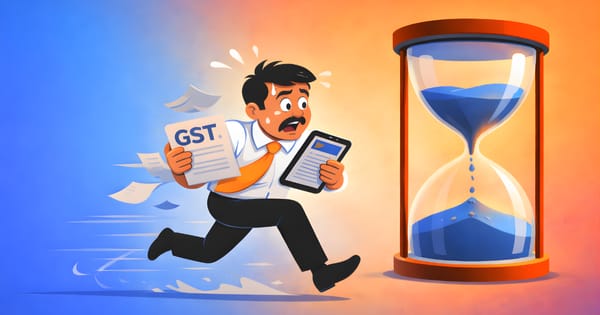
AI Generated
Delay in paperwork is part of doing business, and it’s an acceptable practice between private entities even when it stretches beyond the committed deadline.
But while dealing with the government, this liberal attitude may turn out to be very expensive, especially if it’s about filing the tax returns.
In a recent ruling, the Supreme Court of India upheld a 100% penalty by the GST department on Sriba Nirman Company which failed to file monthly returns, even though the entire tax was paid much before the show-cause notice arrived.
According to the court, this non-compliance amounts to suppression of facts with intent to evade tax.
Tax Filing Not Optional
Many companies still see monthly GST returns as routine compliance, which can be regularised once cash flows improve.
In this case, the company from Rajahmundry, Andhra Pradesh, had raised nine invoices between July 2017 and March 2018, with a total value exceeding ₹920 crore, including GST. Yet, no GSTR-3B returns were filed during this period.
From the tax department’s point of view, the turnover did not exist because it was not filed.
The matter first reached the Andhra Pradesh High Court which ruled earlier this year that the 100% penalty was justified.
The company then moved the Supreme court which also treated this absence seriously, because under the Central Goods and Services Tax Act, non-filing of mandatory returns is deemed to be suppression of facts.
The court also ruled that filing of returns and payment of tax at a later stage does not undo the earlier non-compliance. Once the deadline to file monthly returns expired, the breach had already occurred, and the absence of returns meant the tax department was kept in the dark.
Rough Business Conditions
The taxpayer argued that the returns were not filed on time because of some financial constraints. Payments from the client were delayed, and the partial receipts were not enough to meet both GST obligations and continue project execution.
The court did not accept this explanation, setting a precedent for contractors and infrastructure players, where GST is often managed around collections.
It said that statutory requirements do not cease to exist because business conditions are rough. It also came up during investigation that the returns were not filed even though some money had been received.
The judgment makes it clear that linking return-filing to cash inflows is a risky approach. Financial difficulty may explain why tax is paid late, but it does not justify why the tax department was not informed on time.
Paid in Advance
Another argument from the business side was that the entire tax amount had been paid almost two years before the show-cause notice arrived. The taxpayer believed this should have stalled penalty proceedings.
The court did not buy this argument either, pointing out that protection under Section 74(5) is available only when tax, interest and a 15% penalty are all paid before the notice.
In this case, interest was paid later and the 15% penalty was never paid. Since the statutory conditions were not met, the department was free to issue the notice and impose a full penalty.
The ruling makes it clear that even when money is tight, the business is exempt from complying with statutory norms, and it won’t get the leeway to fix things later.

$677 Billion
That’s the fortune of Elon Musk on his way to becoming the world’s first trillionaire. Earlier this month, Musk’s SpaceX launched a tender offer valuing the firm at $800 billion, up from $400 billion in August. That boosts the fortune of Musk, who owns an estimated 42% of SpaceX, by $168 billion to an estimated $677 billion. Musk is now the first person ever worth $600 billion or more. No one else has ever been worth $500 billion. The tender offer comes as SpaceX is targeting an IPO in 2026 that could value the company at around $1.5 trillion.
—Only BS-IV & above vehicles exempt from action in Delhi. Only vehicles with BS4 engines will be exempted from action if they are found plying in Delhi, the Supreme Court said this week, modifying its earlier order banning 10-year-old diesel-run vehicles and 15-year-old petrol-run vehicles from December 18. A 15-year-old petrol-run vehicle in India and its 10-year-old diesel counterpart likely have a BS-III (Bharat Stage 3) engine. Earlier, the Supreme Court had ordered that no strict action would be taken against 10-year-old diesel and 15-year-old petrol vehicles.
—Trump has an alcoholic personality, says aide. White House Chief of Staff Susie Wiles has disputed portions of a Vanity Fair article in which she paints an unflattering picture of the Trump administration and many of its top officials. In the interview, Wiles described Donald Trump as having an “alcoholic's personality” and Vice President JD Vance as having been a “conspiracy theorist” for a decade. But in a post on X, Wiles said that Vanity Fair disregarded “significant context” to create “an overwhelmingly chaotic and negative narrative” about the administration. In a separate interview, Trump defended Wiles, describing her as "fantastic" and suggested she had been "deceived" by the writer.
—Warner Bros to reject $108bn Paramount bid. Warner Bros Discovery will urge its shareholders to reject Paramount Skydance's $108.4bn takeover bid as soon as Wednesday, according to reports. Paramount has said its offer is “superior” to a $72bn deal that Warner Bros struck with Netflix for its film and streaming businesses. At the same time, a key backer of Paramount's attempt to buy Warner Bros, Affinity Partners, has reportedly pulled out of the bid, citing the involvement of “two strong competitors”. Affinity was founded by US businessman and President Donald Trump's son-in-law Jared Kushner.
—Former UK chancellor George Osborne joins OpenAI. Former chancellor George Osborne is joining AI giant OpenAI. He will lead its ‘OpenAI for Countries’ programme, which is aimed at helping governments increase their AI capacity. Announcing his new London-based role, Osborne said it was a privilege to be joining the company. The announcement follows news that government-level negotiations between the UK and the US over a tech deal that included greater co-operation in AI have faltered.
—JioStar appoints GR Arun Kumar as CFO. JioStar has appointed G R Arun Kumar as its chief financial officer. Kumar earlier led Welspun Group as group CFO and head of strategy, overseeing finance, planning, mergers and acquisitions, compliance, and investor relations, according to an internal company email. The appointment comes at a time when the media group is looking to cut losses across businesses. Its streaming platform, JioHotstar, could also face tougher competition from Netflix after the latter announced it is acquiring Warner Bros’ film and TV studio.
ICYMI | The Jumpy Middle Order
Missed last week's update? Forecasting demand becomes difficult for companies when buyers pull in three different directions — premium, value, and a restless middle whose preferences are choices are particularly hard to predict. India seems to be hitting that stage now, where CFOs can learn a thing or two from their US counterparts who have started tweaking prices and products to retain all three segments.
Was this email forwarded to you?
The CFO Weekly Digest is a weekly newsletter brought to you in collaboration with The Core.